
Guidance for families navigating foreclosure protection.
A thoughtful, plain-language companion for the moment your home's future becomes uncertain. Written for families facing difficult decisions, timelines, and financial pressures all at once.
Understanding foreclosure in your state
Validating your rights, understanding the legal process, and what each stage means for your family's timeline and options.
How your financial options fit in
Exploring loan modifications, refinancing, forbearance, deed-in-lieu, and moving forward at the pace that's right for your family.
What to expect when we talk
A private, no-pressure conversation about your options, even if you're not ready to make decisions yet.
Solutions handled with care
Credit guidance, financial rebuilding, and next steps handled with respect and dignity for your family.
A plan tailored to your timeline
Every family's journey is unique, and so is the path forward.
Understanding foreclosure in Maryland
Foreclosure is the legal process a lender uses to recover a property after missed mortgage payments. In Maryland, that process is built with real protections and built-in time — which means homeowners almost always have room to act.
Most residential foreclosures in Maryland are "quasi-judicial." A court is involved, lenders must send specific notices, and you're given the chance to request mediation and pursue alternatives before any sale can happen.
The single biggest factor in how a foreclosure ends is how early you take action. The sooner you understand your numbers and your options, the more of them you'll actually have available.
Time is built in
Federal rules generally require lenders to wait until you're 120+ days behind before filing in court.
You'll get formal notice
A Notice of Intent to Foreclose must arrive at least 45 days before a lender can file.
You can reinstate
You can usually bring the loan current up to one business day before the sale.
Common reasons homeowners fall behind
Falling behind is rarely about poor planning — it's about life changing faster than a budget can. If any of these sound familiar, you're in good company, and you have options.
Job loss or reduced income
A layoff, cut hours, or a slow stretch for the self-employed can change everything in a single month.
Medical emergencies
Unexpected illness, injury, or medical bills can quickly pull money away from the mortgage.
Divorce or separation
One household becoming two often makes a once-comfortable mortgage hard to carry alone.
Loss of a loved one
The death of a spouse or co-borrower can remove income and add inherited financial weight.
Payment or cost increases
An adjustable rate resetting, or rising taxes, insurance, and HOA dues, can stretch a budget thin.
Inherited or unexpected repairs
An inherited home with a mortgage, or a sudden major repair, can outpace what you planned for.
Signs you should act now
The best time to explore your options is before a missed payment turns into a notice. If you recognize a few of these, it's worth a confidential conversation today.
You've missed a payment — or you're about to.
You're using credit cards to cover everyday essentials.
You've received a late notice or an escrow shortfall letter.
You're dipping into savings or retirement to make the mortgage.
You've started avoiding calls or mail from your lender.
A life change (job, divorce, illness) just made the payment hard.
What to do immediately if you're behind
A few early steps protect your options and your peace of mind. None of them commit you to selling — they simply put you back in control.
Open every letter
Don't set notices aside. Each one carries deadlines and rights that matter to your timeline.
Know your numbers
Find out what you owe versus what your home is worth today. Many homeowners have more equity than they expect.
Call a housing counselor
HUD-approved counselors offer free guidance. Maryland's HOPE Hotline is a confidential place to start.
Contact your servicer
Ask specifically about loss mitigation — modification, forbearance, or a repayment plan you may qualify for.
Talk to a local REALTOR®
Understanding your sale option early keeps it available. It costs nothing to know where you stand.
Act before the sale date
Your rights and choices are widest early in the process and narrow as a sale approaches.
Where you are matters more than how you got here
Maryland's process moves through clear stages — each one an opportunity to act. Here's how it typically unfolds, and why every stage still leaves a door open.
Falling behind & early notices
After a missed payment, your servicer sends reminders and a notice of default. Federal rules generally prevent a court filing until you're more than 120 days past due — time meant for you to explore solutions.
Notice of Intent to Foreclose (NOI)
The lender must mail a formal NOI at least 45 days before filing. For owner-occupied homes it includes a loss-mitigation application and mediation information — your invitation to negotiate.
Order to Docket filed in court
This court filing formally begins the foreclosure. It can't be filed until the later of 90 days after default or 45 days after the NOI — and you're served a copy along with a mediation request form.
Foreclosure mediation
You can request mediation within 25 days of the Order to Docket. The state schedules a session — typically within 60 days — where you sit down with your servicer to pursue an alternative to a sale.
Notice of sale
If matters aren't resolved, the sale is advertised in a newspaper for three weeks, and notice is mailed to you 10 to 30 days beforehand. A sale can't occur sooner than 15 days after mediation.
Foreclosure sale & ratification
The home is sold at public auction, then the court must ratify the sale before title transfers — with a window to file exceptions. Up until a sale, you typically still hold the right to reinstate.
In Maryland you can generally bring your loan current — paying past-due amounts, fees, and costs — up to one business day before the foreclosure sale. The earlier you act, the more affordable that becomes.
Carole Webb is a licensed REALTOR®, not an attorney or a tax adviser. Nothing on this page is legal, financial or tax advice. For questions about your legal or tax situation, please consult a Maryland attorney or tax professional.
Your options before foreclosure
Foreclosure is rarely the only outcome of falling behind. Depending on your equity, your loan, and your timeline, one of these paths may protect your finances and your future.
Loan modification
Your lender permanently changes the loan terms — rate, length, or balance — to bring the payment within reach.
Forbearance
A temporary pause or reduction in payments while you recover from a short-term hardship, with a plan to catch up after.
Repayment plan
Missed payments are spread across future months so you can gradually catch up without paying everything at once.
Refinancing
Replacing your loan with new terms or a lower rate — an option when your credit and equity still support it.
Sell before foreclosure
If you have equity, selling can pay off the mortgage, keep foreclosure off your record, and let you move on with cash in hand.
Short sale
When you owe more than the home is worth, the lender may agree to accept less than the balance to avoid foreclosure.
Eligibility depends on your specific situation, loan type, and lender. A consultation helps you understand which of these options realistically fit you.
Common foreclosure myths
Fear and misinformation cause many homeowners to wait too long. Here's what's actually true.
"Miss one payment and I'll lose my home right away."
Maryland's process builds in months of notices, a mediation step, and a right to reinstate up to one business day before any sale.
"Once foreclosure starts, there's nothing I can do."
Options remain at nearly every stage — mediation, loss mitigation, reinstatement, or selling before the sale date.
"Selling won't help because I owe too much."
Many homeowners have more equity than they realize. Even when underwater, a short sale may still be possible.
"After foreclosure, I'll never own a home again."
Many Marylanders buy again within a few years. Loan programs have defined waiting periods, and credit can be rebuilt.
"Talking to a REALTOR® means I'm committing to selling."
A consultation is simply information. You leave knowing your options — not obligated to choose any of them.
"It's safer to wait and hope things turn around."
Waiting almost always removes options. Acting early is the single most powerful thing you can do.
Foreclosure isn't the end of homeownership
Many people in Prince George's County become homeowners again after a hardship. Waiting periods vary by loan type, and rebuilding your credit plays a major role — but the door reopens.
FHA loans
Often available roughly three years after a foreclosure, sometimes sooner with documented extenuating circumstances.
VA loans
Eligible veterans and service members may qualify in about two years after foreclosure.
Conventional
Typically a longer wait, which can shorten when extenuating circumstances are well documented.
These are general guidelines only — actual waiting periods and requirements vary by lender, program, and circumstances. Confirm details with a licensed mortgage professional. Carole can help you build a step-by-step plan to be ready when the time comes.
In August 2007, I lost my home.
I was working at the flower shop I owned near my home when a neighbor came to find me. She told me my belongings were being put outside in my yard.
I knew we were facing foreclosure. I did not believe we would be removed from our home that day. I had sought legal guidance and left with the understanding that I had until January. In my mind, I still had time — time to understand what was happening, time to prepare my family, time to decide what we would do next.
Instead, while I was at work, our furniture, our clothing, our family belongings — pieces of our lives — were being carried out of our home and placed outside.
I did not go home right away. I could not. I drove to the community center on Glenn Dale Road, sat there, and cried.
That day is the reason I do this work. It is also why nothing you tell me will surprise me — and nothing about your situation will make me think less of you.
Read the rest of my storyCarole Webb, REALTOR® · 2026 President, Prince George’s County Association of REALTORS®
A steady guide through an uncertain moment
You don't need to have it all figured out before you reach out. Carole's role is to help you see the whole picture clearly, then move at the pace that's right for you.
- Review your situation, confidentiallyA private look at your equity, timeline, and where you stand today.
- Walk through every optionModification, short sale, selling, or staying put — explained in plain language.
- Help you sell before foreclosureIf selling is the right move, she'll position your home to sell quickly and protect your equity.
- Connect you with trusted professionalsAttorneys, housing counselors, and lenders when your situation calls for them.
- Guide you toward rebuildingA path back to homeownership when you're ready to own again.

"Every home has a story — and my story helps you move smarter."
Carole entered real estate because of her own experience with foreclosure. She understands how quickly life can change, and she meets every homeowner with empathy instead of judgment.
Her mission is simple: help families in Bowie, Upper Marlboro, and across Prince George's County understand their options and take the next step with confidence.
Resources for Prince George's County homeowners
These independent, free or low-cost organizations support Maryland homeowners facing foreclosure. Reaching out to one of them early is always a smart move.
Maryland HOPE Hotline
Free HUD-approved housing counseling
Community Legal Services of PG County
Local legal assistance for homeowners
Maryland Court Help Center
Free help for self-represented homeowners
Maryland Legal Aid
Civil legal services across the state
These organizations are independent of Carole Webb and Samson Properties and are listed as a public service. Contact details can change — please verify before relying on them.
Foreclosure & short sale questions in Maryland
Maryland follows a quasi-judicial process: after you fall behind, your lender sends a Notice of Intent to Foreclose, then files an Order to Docket in court, offers mediation, and only then can schedule a sale. Each stage has notice requirements and deadlines, which is exactly why understanding your timeline early gives you the most options.
For many homeowners a short sale has less long-term impact than a completed foreclosure, but every situation is different. The right answer depends on your equity, your hardship, your loan, and your goals. A consultation helps you compare them honestly for your circumstances.
Sometimes a lender may pursue a remaining balance, and sometimes they waive it — it varies by lender and situation. Because this has financial and legal implications, you should review your specific case with a qualified attorney or financial professional before proceeding.
The best approach is a local comparative market analysis based on recent sales in your community. Carole provides a free, no-obligation home value review so you can see your equity position and make an informed decision from there.
Yes. FHA, VA, and conventional loans each have defined waiting periods, and rebuilding your credit during that time makes a big difference. Many Prince George's County families become homeowners again — Carole can help you map out the steps so you're ready when the time comes.
Usually more time than it feels like. A Maryland lender must send a Notice of Intent to Foreclose at least 45 days before it can file, and once a case is filed there are further required notices, a right to request loss mitigation, and in many cases mediation. From first missed payment to a foreclosure sale commonly runs many months, though the exact timeline depends on your lender and your case.
Yes. Right up until the foreclosure sale actually occurs, you can sell the home. If there is equity, selling is how you keep it — at a foreclosure sale that equity is at risk. Time is the only real constraint, so the earlier this starts, the more options exist.
Loss mitigation is the lender’s process for reviewing alternatives to foreclosure: a loan modification, forbearance, a repayment plan, a short sale, or a deed in lieu. In Maryland the lender must include a loss-mitigation application with the foreclosure paperwork, and you have the right to submit it and to request mediation.
Generally no. A completed foreclosure is among the most damaging entries on a credit report and stays there for seven years. A sale that pays the loan off in full does no credit damage at all. A short sale sits in between. Which one applies to you depends on whether the home is worth more than what is owed against it.
Take the current market value and subtract every lien — first mortgage, any second or HELOC, judgments, tax liens. Many Prince George’s County homeowners who bought before the last several years of appreciation have considerably more equity than they realize, and that single number changes the entire conversation.
Nothing. Carole reviews the situation confidentially and walks through every option, including the ones that do not involve listing the home. There is no fee and no obligation for the conversation.
Open every letter from your lender and call your mortgage servicer. Ask what options they offer, such as a repayment plan, forbearance or a loan modification, and write down who you spoke with and when. A free HUD-approved housing counselor can help you understand the options and prepare the paperwork. The earlier you act, the more choices you usually have.
Start with a HUD-approved housing counseling agency. Their help is free, and they can talk with your lender on your behalf. Maryland's Department of Housing and Community Development also runs the Maryland HOPE program for homeowners facing foreclosure. If you have legal questions about your case, talk with an attorney or a legal aid organization.
If Prince George's County property taxes go unpaid, the county can sell a lien on the property at its annual tax sale. That doesn't mean you lose the house right away. Owners generally have a period to redeem by paying the overdue taxes plus interest and costs, but the amount grows over time and the lien holder can eventually go to court. Contact the county's Office of Finance as early as possible, and talk with an attorney if a lien has already been sold.
Yes. Maryland has strict rules for foreclosure "rescue" arrangements because some offers end with homeowners losing their equity. Be cautious of anyone who asks for fees up front, asks you to sign over your deed, or tells you to stop talking to your lender. Get advice from a housing counselor or attorney before you sign anything.
The sooner you start, the more control you have.
If you're facing foreclosure or weighing a short sale in Bowie, Upper Marlboro, or anywhere in Prince George's County, don't wait until it becomes urgent. One confidential conversation can change everything.
Private. Confidential. No pressure — just a plan.

Free download
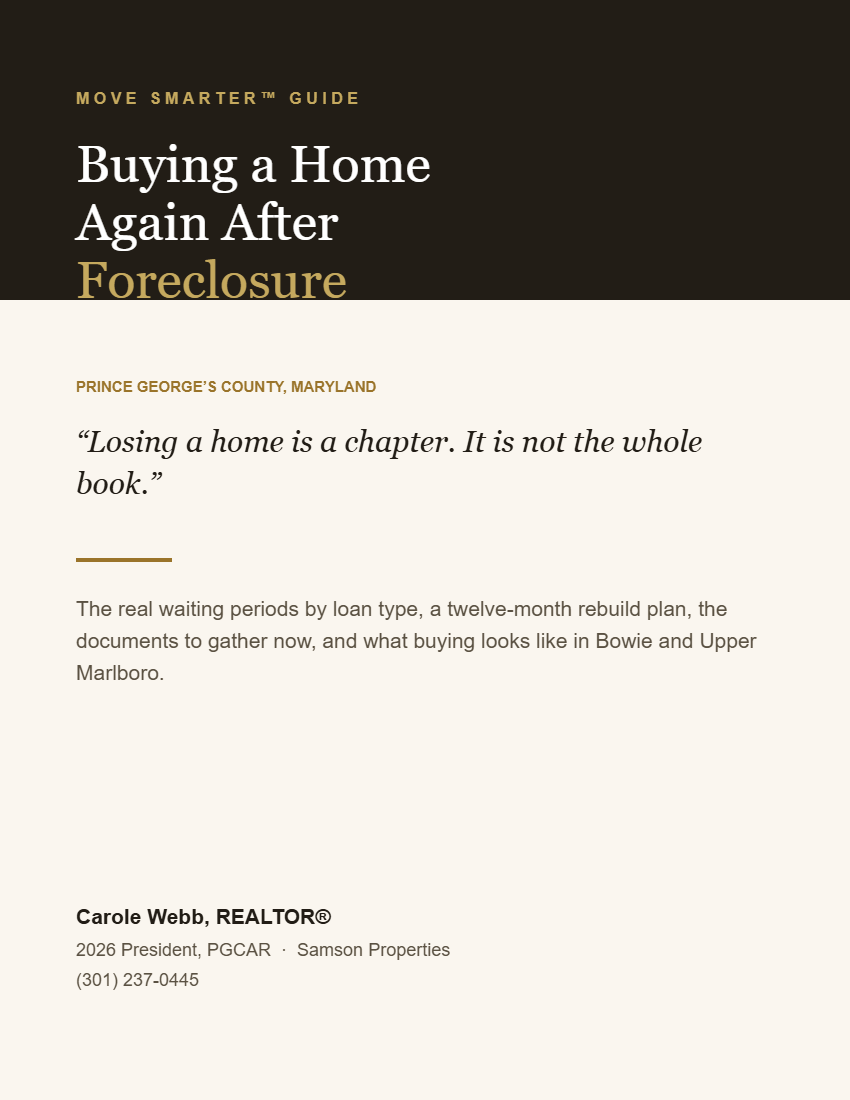
Buying a Home Again After Foreclosure
I lost a home. I rebuilt. Then I got my license so the next family in that position would have someone who had actually walked it. This is the plain-English version of that conversation.
- The real waiting period for FHA, VA, USDA and conventional — and how it is counted
- What underwriters accept as an extenuating circumstance
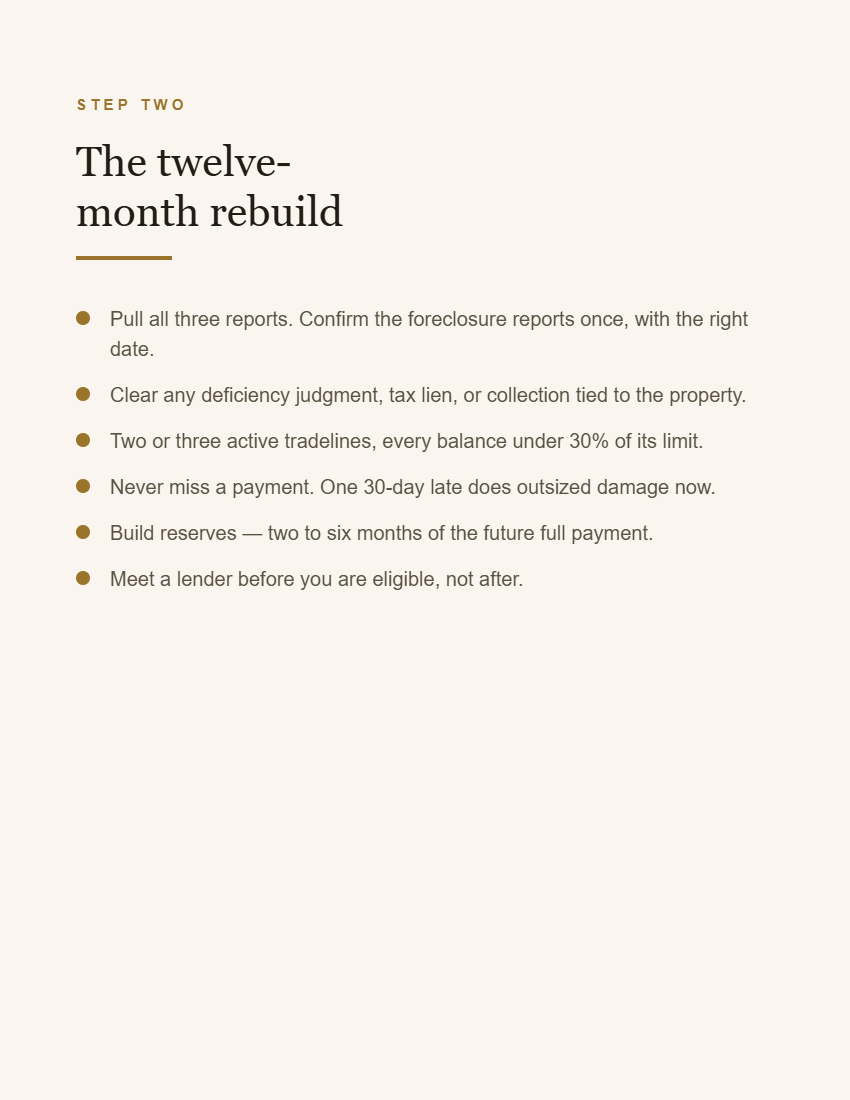
- A twelve-month rebuild plan you can start this week
- The documents to gather now, and three questions for any lender
- Down payment help available here in Prince George's County
Prefer to just talk it through? Call or text (301) 237-0445.